
Do what you can

“Do what you can, with what you have, where you are.”
- Theodore Roosevelt1
I woke with burning nerve pain in my extremities. Small muscle spasms fluttered in my legs, like twinkling stars in the night sky, with the bite that you feel when licking the terminals of a 9-volt battery. A symphony of high-pitched ringing played in my ears, assaulting my senses. I felt exhausted but was thankful that keeping my eyes open did not feel like an impossible task today.
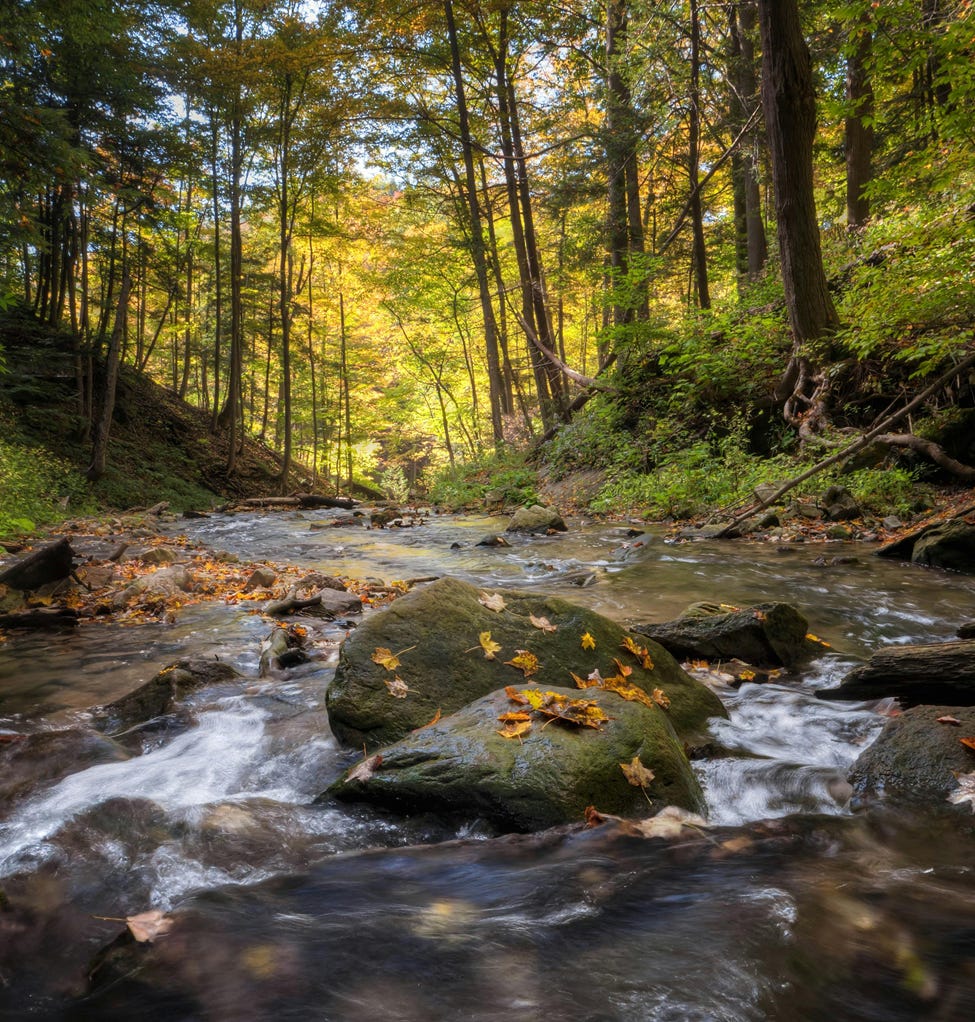
On a day like this it would be tempting to immediately resort to numbing – medicate the pain, distract from the tinnitus and exhaustion with entertainment, eat something sugary and delicious. What I did was more difficult. Take supplements, hydrate, morning tea. Recite a calming verse of scripture, say a prayer. A podcast on trauma instead of catching up on the latest news of the NFL offseason. An early morning walk down by the creek, listening to the water flowing over the rocks, watching a young squirrel try to figure out if I am friend or foe. Breathe.
“He lets me rest in green meadows; he leads me beside peaceful streams.”
The Psalmist’s refrain rings in my ears, resonating with body and spirit.
Noticing some fresh greenery sprouting from the moist dirt, I pause and lean low toward the earth to grasp a cluster of wild onion grass, plucking it for an early morning snack, a reminder that everything we depend on for life has been given to us through the natural world.
“The LORD is my shepherd; I have all that I need.”
The Psalmist arrives again with the words to express what I feel.
My life today feels a bit like that creek – meandering along a path carved out long beforehand, flowing out of its source naturally and inexorably toward its destination. And yet, how easy it would be to give up the moment I wake up to the cacophony of ringing in my ears, the chaos of fluttering muscle fibers and burning nerves, the exhaustion that feels like it could outlast a week of sleep.
I didn’t face it alone. It began when I rediscovered the Roosevelt quote this morning written on a card given to me by a former coworker. It helped me reframe the way I was seeing my problems, allowing me to feel hopeful. The podcast was a recommendation from Laura – her favorite psychiatrist (and now mine) has a way of weaving together emotional, relational, and spiritual truths. It helps me to understand that I’m not the first person to carry this, that there are patterns and ways of understanding what I’m going through. The Psalmist gave me words for my feelings and connected me to thousands of years of human experience. The natural world was given to me with everything I need to regulate and nourish my body. The sound of the creek spoke to my nervous system in a language older than words, calming and soothing me.
Healing, I’m learning, isn’t about one solution, like finding a key for a locked door. It’s more like growing a root system beneath a tree, reaching down into the earth in every direction to draw life from the soil, nutrients and water arriving from many different sources to feed and nourish, each one necessary, none of them sufficient alone.
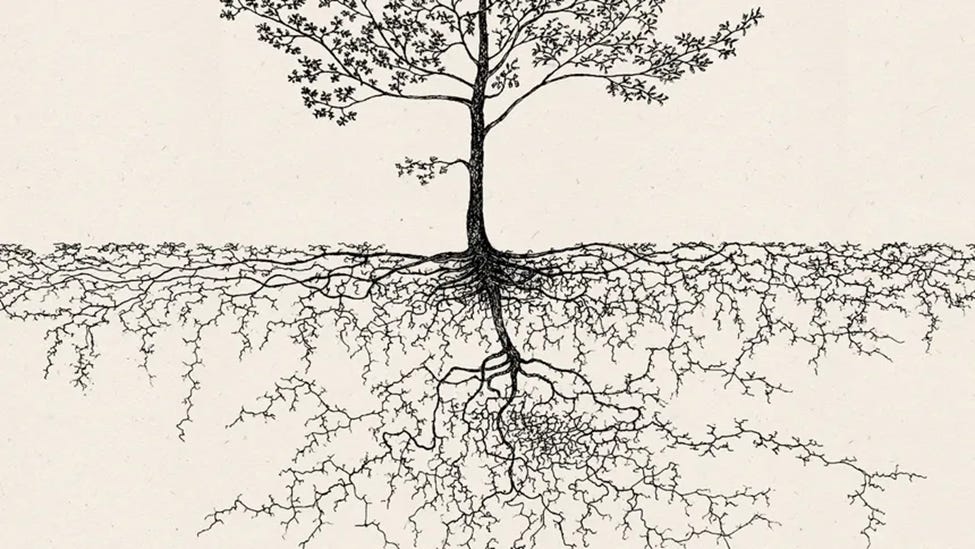
Healing, I’m learning, isn’t about one solution, like finding a key for a locked door. It’s more like growing a root system beneath a tree, reaching down into the earth in every direction to draw life from the soil, nutrients and water arriving from many different sources to feed and nourish, each one necessary, none of them sufficient alone.
Laura is one of those roots – perhaps the deepest one. I’ll go back to the creek later with her. We found a spot close by where we can set up a cot (for me) and a beach chair (for her), within earshot of the swimming hole near our house, so we can hear the water running over the rocks that hold back the flow of the stream while we talk. I’ve noticed a physiological response when I spend more than a few minutes down there – my nervous system noticeably relaxes and I feel more at ease. For all of the meditation, breath work, Tai Chi, and yoga I have tried (and found effective) nothing relaxes me like being in nature. Laura has a similar effect on me – something about her physical presence settles my nervous system. Beneath that is the quieter comfort of being deeply known and accepted by someone who has seen me at my worst and loves me no less. There is something about being loved well that makes it easier to be still.
Beneath that is the quieter comfort of being deeply known and accepted by someone who has seen me at my worst and loves me no less. There is something about being loved well that makes it easier to be still.
These were “what I [had]” this morning – a rediscovered quote, an insightful podcast, ancient poetry, a woman who loves me, and a bubbling creek. Perhaps if I were designing a life, there are other things I would have chosen. But this is what I was given. And I’m learning that the gifts we are given are not always what we would have asked for, but they are often what we need.
That’s where dependency and agency meet. Dependency isn’t passivity – it’s the honest acknowledgment that we didn’t create the soil we’re rooted in. The creek was here before me. The Psalmist wrote three thousand years ago. Laura chose to love me. We receive far more than we create. But agency is what we do with the gifts – whether we reach toward what’s been given or turn away from it. The temptation on a morning like this is to refuse the gifts: to numb instead of feel, to isolate instead of connect, to scroll instead of walk to the creek. Agency, in its quietest form, is simply the choice to accept what’s already there.
So I find hope in that brief, simple quote. I woke up where I am, with what I have. It’s not where I would have chosen to be. But I woke up able to do what I can, with people who support me. That’s not nothing.
And so this morning, I will stretch my root system deep, down into the dark, moist soil, drawing on every healing resource and relationship that has been given to me. I will resist the pull to numb and escape. I will be grateful that I am not alone, that I have what I need to sustain me. I will enjoy the ordinary luxuries of nature, rest, reflection, and relationship. I will do what I can.
Full disclosure, Roosevelt is widely credited with this quote, but he attributed it to Bill Widener in his 1913 autobiography.
There is a profound bravery in your 'quietest form of agency.' By choosing to reach for the creek and the Psalm rather than the numbing escape of the 'aesthetic' life, you are doing exactly what Kierkegaard described as the 'double movement' of faith: acknowledging the '9-volt' reality of your pain, yet choosing to exist fully within it anyway. You’ve moved from being a victim of your nerves to being, as he might say, a 'Knight of Faith'—someone who finds the infinite in the ordinary.
Your 'root system' metaphor also captures what Neil Douglas-Klotz teaches about Rukha (the Breath). He would see your walk by the water not just as exercise, but as a literal re-tuning of your vibration to the natural world. In the Aramaic tradition, 'healing' isn't a destination; it’s a return to resonance. When you describe Laura’s presence settling your nervous system, you’re describing a holy co-regulation—the 'quiet comfort' of being known is, perhaps, the deepest root of all.
Thank you for reminding us that while we don't choose the soil we are planted in, we always have the agency to stretch our roots toward the water.
Agency means not giving up.